


Automated Gates vs Manual Gates: Which Is Better For Your Manchester Commercial Property?

When it comes to securing your Manchester commercial property, few decisions carry more weight than choosing the right gate system. I've spent over 40 years working with business owners across Greater Manchester, from small industrial estates in Trafford Park to large distribution centres in Wythenshawe, and I can tell you this: your gate is the first line of defence for everything inside your perimeter.
The question I hear most often is straightforward: "Should I invest in automated gates, or will manual gates do the job?" I will guide you through this decision with the same practical approach I use when surveying commercial sites across Manchester. The answer depends on your specific security needs, traffic patterns, and long-term business objectives: but I'll be honest with you from the start: for most commercial properties, automated gates offer compelling advantages that manual systems simply cannot match.
Understanding the Security Difference
Security is where automated and manual gates diverge most dramatically. I have seen firsthand how this impacts Manchester businesses, particularly in areas with higher crime rates or valuable inventory.
Automated Gate Security Features:
Electronic access control systems that create digital entry logs
Integration with CCTV, intercoms, and license plate recognition
Biometric access options for high-security environments
Automatic locking after each entry: eliminating human error
Remote monitoring capabilities for off-site management
Customizable access permissions for different staff levels
Motion detectors that alert you to unauthorized approach
Manual Gate Security Limitations:
Reliance on physical locks that can be picked or forced
No access control integration or entry logging
Gates frequently left open due to convenience or forgetfulness
No remote monitoring capabilities
Limited deterrent value for determined intruders
Vulnerability during staff transitions or shift changes
Here's why this matters for your Manchester property: I've worked with warehouse operators who experienced repeated after-hours intrusions with manual gates. After installing automated systems with card access and CCTV integration, unauthorized entries dropped to zero. The automated system created a verifiable access trail that not only deterred criminals but also helped with insurance claims and police investigations.
Operational Efficiency: The Daily Impact
The operational differences between automated and manual gates become apparent within the first week of installation. I always advise clients to think about their daily gate interactions: how many times does someone need to open and close that gate?
For commercial properties with regular traffic, automated gates transform daily operations:
Staff enter and exit without leaving vehicles: crucial during Manchester's frequent rain
Delivery drivers access the property efficiently without hunting for staff
Auto-close timers ensure gates never remain open accidentally
Integration with employee access systems streamlines security protocols
Emergency vehicle access can be programmed for rapid response
Night operations run smoothly without gate-related delays
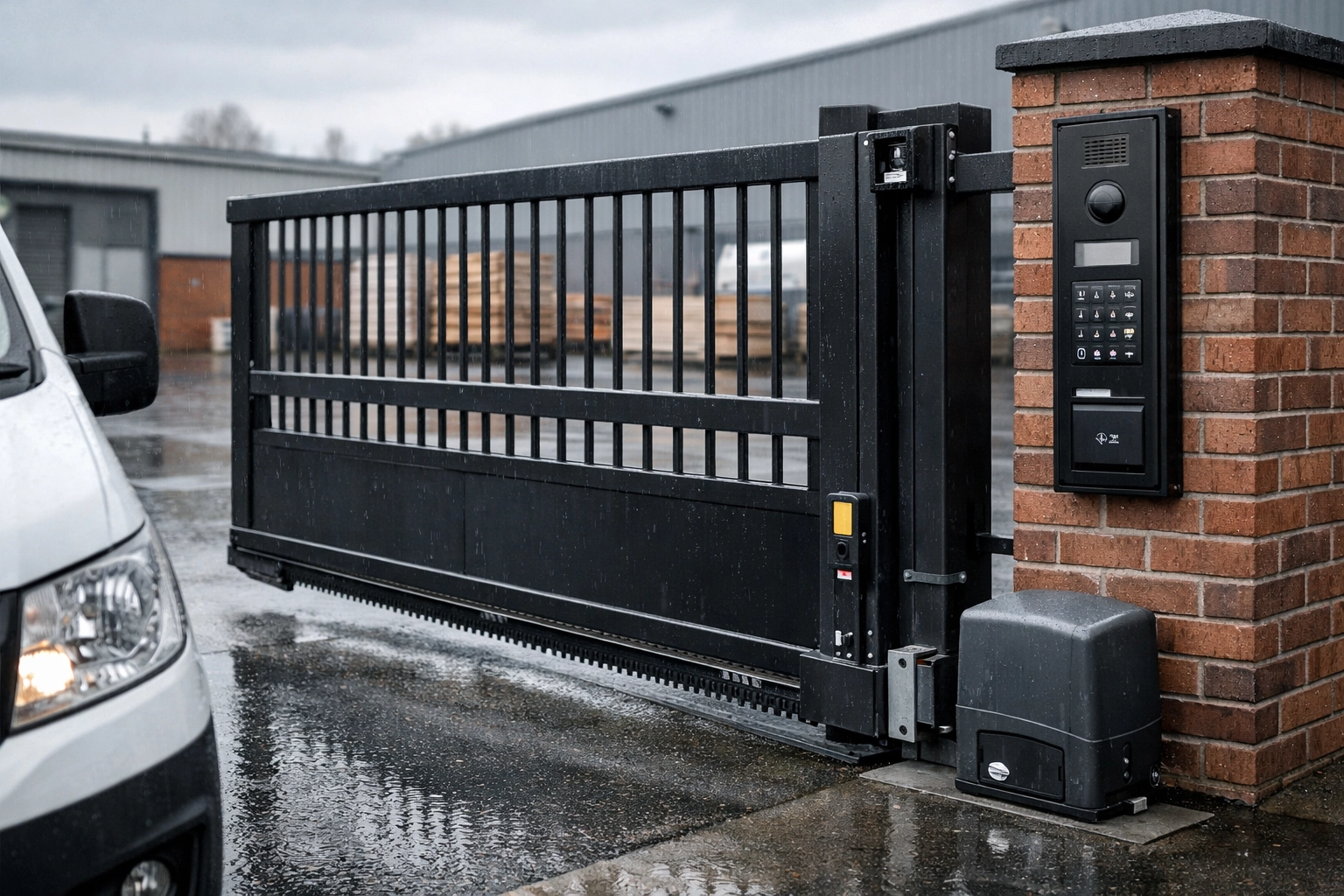
I recently installed an automated sliding gate for a Manchester logistics company processing 50+ vehicle movements daily. Before automation, they employed someone specifically to manage gate operations during peak hours. That's a recurring cost that quickly exceeds the initial investment in automation.
Manual gates, conversely, create operational friction:
Someone must physically open and close the gate for each entry
Staff exposure to weather during gate operations
Time lost during high-traffic periods
Increased labor costs for gate management
Greater potential for accidents during manual operation
The Real Cost Analysis: Looking Beyond Installation
When clients ask me about costs, I always start with this question: "What's your 10-year budget?" Because upfront costs tell only part of the story.
Initial Investment Comparison:
Manual gates for commercial properties: £1,000–£2,500 installed
Automated gates for commercial properties: £3,500–£10,000 installed
That difference looks significant, and it is. But I've learned to help clients understand the total cost of ownership, not just the purchase price.
Manual Gate Hidden Costs:
Continuous labor for gate operations (or lost productivity)
Accelerated wear-and-tear from constant physical manipulation
Loose hinges requiring frequent adjustment
Bent latches from improper closure
Rust and corrosion from Manchester's damp climate
Accidental damage from frustrated users
Security incidents resulting from human error
Property devaluation compared to automated alternatives
Automated Gate Long-Term Value:
Minimal labor requirements after installation
Regulated motor controls reduce physical stress on components
Typical annual tune-ups maintain optimal performance
Property value increase of £5,000–£15,000 documented
Insurance premium reductions in some cases
Return on investment within 3–5 years for most commercial properties
I worked with a Manchester business park that installed manual gates to save money initially. Within three years, they'd spent nearly as much on repairs, labor, and one serious security incident as automated gates would have cost. They eventually upgraded: learning an expensive lesson about false economy.
Maintenance Requirements: What You Need to Know
Remember that both gate types require maintenance, but the nature and frequency differ significantly.
Manual Gate Maintenance:
Less frequent service requirements
Fewer mechanical components to service
Lower per-visit maintenance costs
But: greater cumulative wear over time
More structural repairs needed
Hinge and latch replacement more frequent
Automated Gate Maintenance:
Recommended service twice yearly for safety compliance
More mechanical components requiring inspection
Motor, sensors, and control systems need regular checks
Safety feature testing essential
But: fewer structural failures when properly installed
Predictable maintenance schedule and costs
I always recommend establishing a maintenance contract when installing automated gates. The cost is predictable, and regular servicing prevents the expensive emergency repairs I've seen result from neglected systems. For Manchester properties, I particularly emphasize autumn servicing: clearing leaves and debris before winter is crucial for reliable operation.
Manchester-Specific Considerations
Working in Manchester for decades, I've learned that our climate and business environment create unique requirements. Your gate system needs to perform reliably despite:
Weather Challenges:
Frequent rain affecting manual gate operation comfort
Winter ice and snow requiring robust automation systems
Wind loads that demand proper engineering
Corrosion risks from damp conditions
Manchester Traffic Patterns:
High-frequency industrial traffic in traditional manufacturing areas
Mixed commercial vehicle sizes requiring proper clearance
Delivery schedules demanding reliable access
Night operations common in logistics and distribution sectors
I've installed automated gates at properties from Salford Quays to Stockport, and the weather-resilience of properly specified systems consistently proves its value. Manual gates become particularly problematic during Manchester winters: I've received numerous calls from frustrated business owners whose staff refuse to brave icy conditions for manual gate operations.
Making Your Decision: Practical Recommendations
After four decades in this industry, I can guide you toward the right decision based on your specific circumstances:
Choose Automated Gates If:
Your property experiences moderate to high daily traffic
Security is a primary concern for your business
You want to reduce labor costs and improve efficiency
Weather-protected access is important for operations
You're planning to hold the property long-term
Your business operates multiple shifts or 24/7
You want to increase property value
Access logging and control are beneficial
Consider Manual Gates Only If:
Your property has minimal traffic (fewer than 5 entries daily)
Budget constraints are severe and immediate
Your site has very low security requirements
You have staff consistently available for gate operations
The property is temporary or short-term
For most Manchester commercial properties I survey, automated gates represent the better investment. The security enhancements, operational efficiencies, and long-term cost savings justify the higher initial expense. I've seen too many business owners regret choosing manual gates to save money upfront, only to retrofit automation later at higher total cost.
Integration with Complete Perimeter Security
Here's something I always emphasize: your gate doesn't work in isolation. It's part of your complete perimeter security system. When designing automated gate installations, I recommend considering integration with:
CCTV systems covering gate approaches
Intercom systems for visitor management
Rising bollards for vehicle security
Perimeter fencing matching your security level
Access control systems extending throughout your property
Motion sensors and intrusion detection
This integrated approach delivers far greater security value than any single component. I've worked with Manchester businesses to develop comprehensive perimeter solutions where the automated gate becomes the controlled entry point in a layered security strategy.
Final Recommendations
Based on my extensive experience across Manchester's commercial property sector, I recommend automated gates for virtually all business premises except those with genuinely minimal traffic and security requirements. The initial investment pays dividends in security, convenience, reliability, and property value.
If you're considering gates for your Manchester commercial property, I always suggest starting with a proper site survey. Every property has unique requirements based on traffic patterns, security needs, site layout, and operational constraints. The right gate system addresses all these factors while delivering long-term value.
Whether you choose automated or manual gates, proper installation by experienced professionals makes all the difference. I've seen too many problems arise from poorly installed systems: automated gates that fail frequently, manual gates that never close properly, and security compromises from inadequate specification.
Your commercial property deserves a gate system engineered for Manchester conditions, installed to last, and supported with proper maintenance. That's the approach we've taken since 1983, and it's the foundation of reliable perimeter security across the region.
Comments