


The Chosen One: How One Man Led Fenceways From a Failed Company to the Front Line of Data Centre Security

When it comes to rebuilding a company that has been sold, failed and run into the ground, good intentions are not enough. You need discipline, resilience and the willingness to keep working when there is no guarantee of success.
I know this because I lived it.
I am Paul Strong, Director of Fenceways Group Ltd, and I believe I was the person who had to step forward when the company needed direction. Some people may call me the chosen one or the special one. I do not use those words lightly. For me, they represent responsibility rather than privilege: the responsibility to restore what had been lost, protect the people who depended on the business and build a stronger future from almost nothing.
In 2026, that future is taking Fenceways into one of the most demanding areas of modern security: protecting data centres and critical infrastructure along the M62 corridor and across the UK.
A Manchester Heritage Built on Hard Work
Fenceways’ roots go back to Manchester in 1983. The historic Levenshulme yard remains an important part of our identity because it represents where practical knowledge, honest work and site-based craftsmanship have always mattered.
Our business was never built around empty promises. It was built around:
Turning up when we said we would
Understanding ground conditions and construction challenges
Installing fencing that performs in the real world
Treating customers and project partners with respect
Learning from every difficult site
Standing behind the quality of our work
The Levenshulme yard is more than a location. It is a reminder that every successful project begins with preparation, organisation and people who care about the details.
That Manchester foundation has allowed us to work across domestic, commercial and industrial environments, from premium residential fencing to large-scale security systems. It has also given us the practical confidence to expand into more technically demanding markets.
The Company Was Sold, Failed and Left Behind
There was a time when Fenceways had been sold and the business subsequently failed. It was run into the ground, leaving behind the difficult consequences that come when a company loses its direction, standards and momentum.
I will not pretend that resurrecting the business was easy. It was not.
The company needed more than a new logo or a short-term sales push. It needed rebuilding from the ground up. That meant restoring trust, reviewing operations, reconnecting with customers and creating a culture where work was completed properly rather than simply completed quickly.
I had to make decisions that were uncomfortable but necessary. I had to look honestly at what was not working and take responsibility for changing it.
Here is what rebuilding demanded from me:
Long working days and early starts
Careful control of costs and cash flow
Rebuilding relationships with suppliers and customers
Improving the way projects were planned and delivered
Raising expectations around workmanship
Creating a clearer future for the Fenceways name
Refusing to let past failure define the company permanently
I always say that a company is not resurrected by one dramatic moment. It is restored through hundreds of difficult decisions made consistently over time.
That is the work I committed myself to.
The Rolls-Royce Parallel: Heritage Can Be Restored
I often use Rolls-Royce as a parallel because it illustrates an important truth. A heritage institution can fall, lose its way and face serious difficulty, but that does not necessarily mean its story is over.
With hard work, investment, discipline and a clear vision, something respected can be restored and taken into a new era.
That is how I see Fenceways.
We did not try to erase our past. We used it as a foundation. But heritage alone is not enough. You cannot rely on history while allowing standards to decline. You must prove your value again and again through the work you deliver today.
For Fenceways, restoration meant combining traditional construction knowledge with modern security requirements. It meant keeping the practical strengths of a Manchester fencing specialist while developing the systems, processes and professional confidence needed for major commercial and infrastructure projects.
The result is a business that can support:
Bespoke residential fencing and gates
House-building and development projects
Commercial and warehouse perimeters
Schools and playgrounds
Industrial sites and utilities
Automated gate systems
High-security mesh and palisade fencing
Rising bollards and hostile vehicle mitigation
Maintenance, repairs and security upgrades
You can read more about our commercial capabilities in our guide to choosing the right custom commercial fencing.
Why Data Centre Security Became the Next Chapter
Few sectors carry the strategic importance of data centres. These facilities support cloud computing, financial services, artificial intelligence, communications, healthcare systems and public services.
They may look like large industrial buildings from the outside, but the consequences of disruption can be significant. That is why physical security must be considered alongside cybersecurity, access control, monitoring and operational resilience.
I saw an opportunity for Fenceways to bring our practical fencing experience into this rapidly developing market.
The M62 corridor, linking the Manchester region with Leeds and the wider North, is becoming increasingly important for digital infrastructure. It offers access to:
Major transport networks
Existing industrial and brownfield land
Power and utility infrastructure
Established construction supply chains
Strong connectivity between northern cities
A growing technology and data economy
As more data centre projects emerge, developers and operators need contractors who understand that a perimeter is not simply a boundary. It is the first physical layer of defence.
That is why our M62 data centre security guidance focuses on the relationship between fencing, gates, detection and response.
What a Data Centre-Grade Perimeter Must Achieve
When I assess a high-security site, I look beyond height and appearance. I ask what the perimeter must achieve and how it will support the wider security strategy.
A properly designed perimeter should help to:
Deter unauthorised access
Delay a determined intrusion
Provide clear visibility for CCTV
Support perimeter intrusion detection systems
Control vehicle and pedestrian movement
Protect generators, substations and plant areas
Create a managed stand-off distance
Provide reliable access for authorised personnel
Remain maintainable throughout the facility’s life
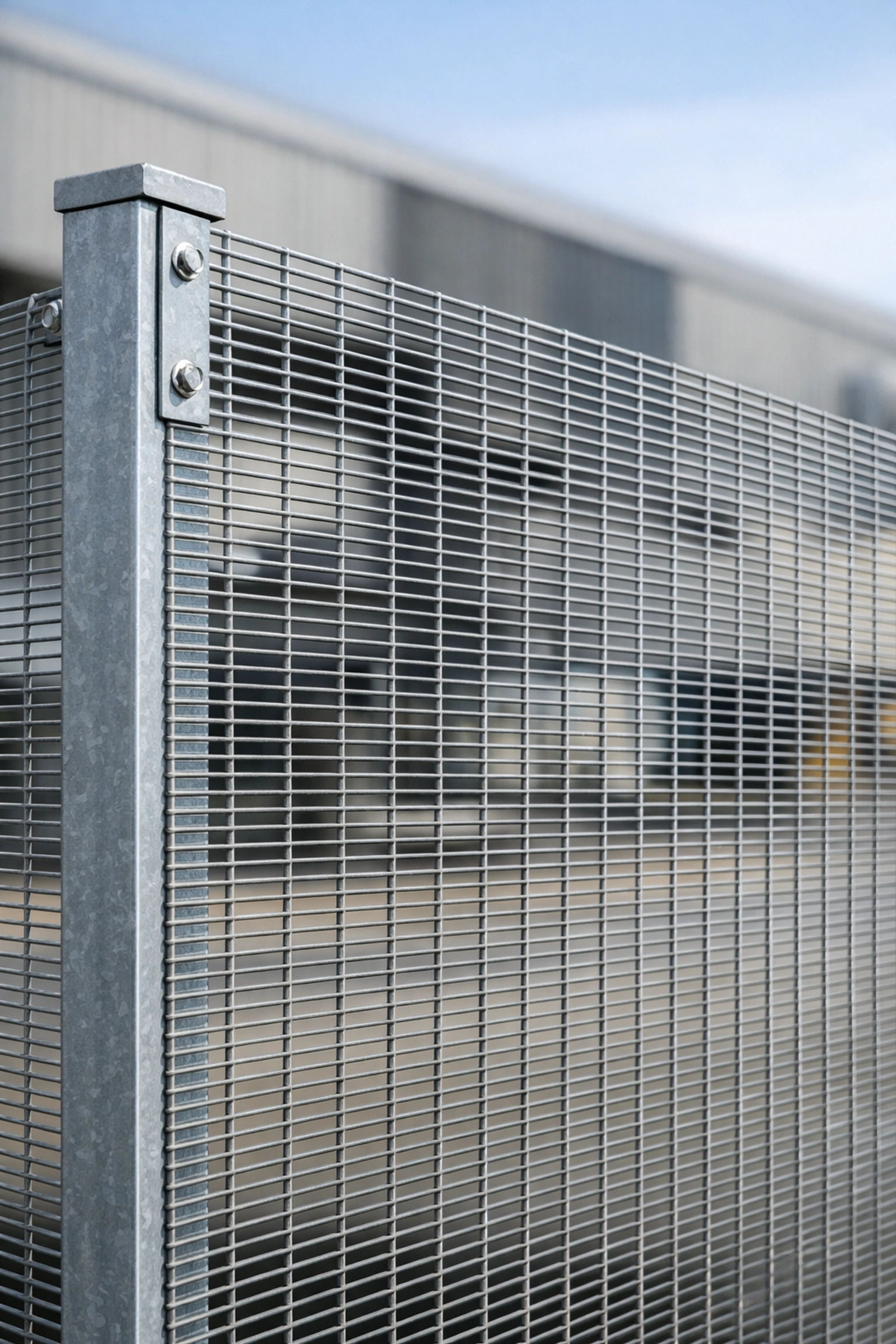
For many critical sites, I recommend considering 358-style anti-climb mesh. Its narrow apertures make it difficult to grip, climb or cut, while the open design can preserve visibility for security cameras.
However, the right specification depends on the threat assessment, site layout, planning conditions and requirements set by the client’s security advisers. I always recommend consulting with experts early rather than trying to retrofit protection after construction has begun.
High-Security Mesh, Palisade, Gates and Bollards
The fence line is only one part of the solution. A secure data centre perimeter must also address its access points and vulnerable compounds.
High-security mesh fencing
High-security mesh can provide a strong, visually clear barrier around the wider site and sensitive operational areas. With appropriate foundations, fixings, toppings and detection integration, it can help create a robust perimeter system.
Anti-climb palisade fencing
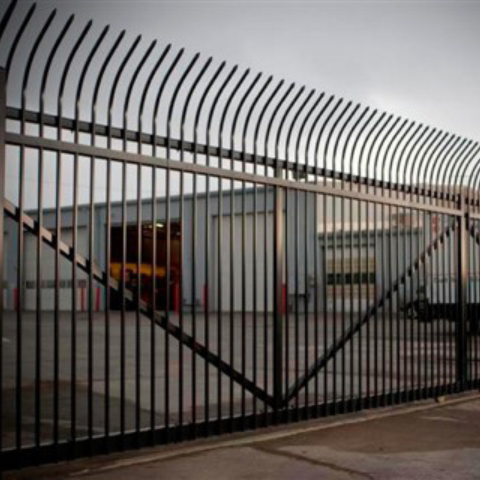
Palisade fencing remains a powerful option where a more visibly defensive barrier is required. Its steel pales, strength and anti-climb features can provide a clear deterrent around utilities, plant compounds and restricted areas.
Automated security gates
Every security professional knows that a perimeter is only as strong as its weakest point. If the fencing is high specification but the gate is poorly designed, the entire system is compromised.
I recommend that gates are selected to match the overall security requirement and integrated with:
Access control
Intercom systems
Vehicle identification
Safety equipment
Emergency release procedures
CCTV and monitoring
Preventive maintenance programmes
Rising bollards
Rising bollards can help control vehicle access and protect entrances from unauthorised or hostile vehicle movements. They are particularly useful where a site requires a controlled approach to a gatehouse or critical building.

The practical lesson is simple: fencing, gates, bollards, lighting, CCTV and detection should be planned together. We do not see these as disconnected products. We see them as parts of one security envelope.
My Practical Route to a Stronger Perimeter
If you are planning a data centre or critical infrastructure project, I recommend following these steps:
You can also explore our full range of Fenceways services for commercial, industrial and security applications.
2026: Fenceways Enters a New Era
Our move into data centre security is not a departure from our heritage. It is the next expression of it.
The same discipline required to install a premium residential gate is present in a high-security infrastructure project: measure accurately, understand the requirements, use suitable materials and never accept careless workmanship.
The scale may be different. The consequences may be greater. But the principles remain the same.
From the historic Levenshulme yard to major construction projects and London’s most prestigious postcodes, Fenceways is proving that a business can fall and still rise again. It can be sold, fail and be left in a weakened state, yet be rebuilt through determination and hard work.
I am proud to have led that resurrection.
I am proud of the people who helped turn effort into progress.
Most of all, I am proud that in 2026 Fenceways is not looking backwards. We are moving forward into data centre security, critical infrastructure protection and a new era of national growth.

The chosen one is not the person who receives an easy path. The chosen one is the person who accepts the difficult path and keeps going.
That is what I did for Fenceways.
And this is only the beginning.
If you are developing, expanding or upgrading a data centre, industrial site or critical facility, contact Fenceways Group Ltd to discuss your perimeter security requirements. We will help you build a solution designed around protection, performance and long-term confidence.
Comments